

Where is my thyroid gland?
The thyroid gland is found at the front of the neck just below the Adam's apple (larynx). It is made up of two lobes that are joined in the middle and sits around the windpipe (trachea). It is often described as butterfly-shaped. In most people, a normal thyroid gland cannot usually be seen or easily felt.

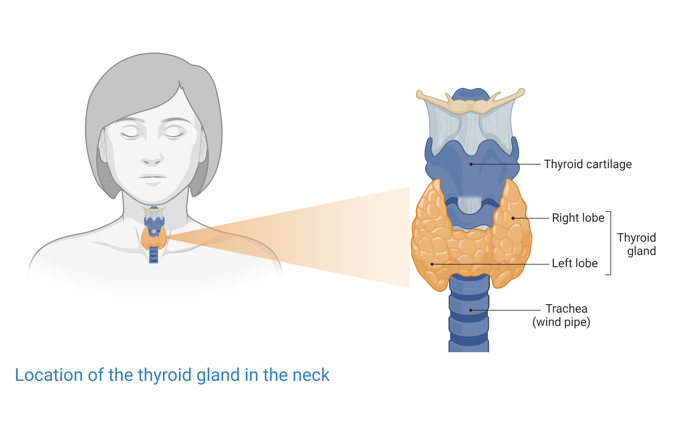
Diagram showing the location of the thyroid gland in the neck. It has two lobes and sits in front of the windpipe (trachea). The voice box (larynx) sits just above the thyroid. Image created using Biorender.
What does the thyroid gland do?
The thyroid gland makes hormones, called thyroid hormones, that travel in the blood to act in different parts of the body. These hormones control how fast the body conducts several processes including important functions such as metabolism, growth and development.
Which hormones does the thyroid gland produce?
The two main thyroid hormones are thyroxine (referred to as T4) and triiodothyronine (referred to as T3). T3 and T4 are collectively called thyroid hormones. The thyroid gland mostly makes T4 (about 80% of the thyroid hormones produced). T4 is also converted to T3 in other parts of the body, such as the liver and kidneys. T3 is the more active hormone, meaning that it has a stronger effect on cells of the body.
The thyroid gland also contains special cells, called parafollicular cells (C-cells). These make a hormone called calcitonin. Calcitonin is involved in bone health by controlling calcium and phosphate levels in the blood.
How is the thyroid gland controlled?
The thyroid gland is controlled by signals from the brain. A small gland at the base of the brain, called the pituitary gland, checks how much thyroid hormone is in the blood and reacts to keep levels stable.
If thyroid hormone levels are too low, the pituitary gland releases another hormone called thyroid-stimulating hormone (TSH). TSH tells the thyroid gland to make more thyroid hormone.
If thyroid hormone levels are too high, the pituitary gland releases less TSH to reduce the amount of thyroid hormone released from the thyroid gland. TSH is a sensitive marker and can change before the level of the thyroid hormone (T4) changes.
Another part of the brain, called the hypothalamus, helps control the pituitary gland. The hypothalamus releases thyrotropin-releasing hormone (TRH), which tells the pituitary gland how much TSH to release to keep thyroid hormones in balance.
Altogether, this system is called the hypothalamic-pituitary-thyroid (HPT) axis. It helps keep thyroid hormone levels balanced.
What could go wrong with the thyroid gland?
In health, the thyroid gland controls the level of thyroid hormones in the blood to maintain balanced metabolism and energy levels. However, in certain conditions, the thyroid gland might not work properly and produce too much or too little hormone:
- Hypothyroidism (underactive thyroid) is when the thyroid gland produces too little thyroid hormones, which are not enough for the body’s needs. This causes slowing of many of the body’s functions including metabolism, heart rate, and feeling tired. This is the most common thyroid disorder.
- Hyperthyroidism (overactive thyroid) is when the thyroid gland is overactive and produces too much thyroid hormones. This causes the body’s metabolism to speed up more than it should and can lead to symptoms such as feeling hot, fast heart rate and losing weight.
Hypothyroidism and hyperthyroidism may be caused by several conditions.
Common causes of hypothyroidism:
- Inflammation of the thyroid gland (thyroiditis). A special form of autoimmune thyroiditis is Hashimoto’s thyroiditis, which occurs when the immune system attacks the thyroid gland, causing cells to break down. Hashimoto’s thyroiditis often runs in families.
- Not having enough iodine in the diet. Iodine is used by the thyroid gland to produce thyroid hormones. Not having enough iodine through the diet is a worldwide problem affecting many people.
- Certain medications.
- Treatment with radioactive iodine.
- Thyroid surgery to remove the thyroid gland.
- Problems with the pituitary gland.
- Thyroid problems present from birth (congenital hypothyroidism)
- Thyroid changes after pregnancy (postpartum thyroiditis)
Common causes of hyperthyroidism:
- Grave’s disease – when the immune system attacks the thyroid gland causing it to become overactive and enlarged (goitre). This can also be associated with symptoms affecting the appearance of the eyes.
- Inflammation of the thyroid gland (thyroiditis). Sometimes this is caused by a viral infection which is called DeQuervain’s Thyroiditis.
- Too much iodine e.g. from the diet or from medications.
- Certain medications such as amiodarone.
- Thyroid nodules (swellings) which can produce too much thyroid hormones
- Problems with the pituitary gland producing too much TSH (e.g. a TSHoma).
Other related symptoms can occur including:
- Thyroid nodules (swellings) – most nodules are non-cancerous (benign), but they may need to be checked by a doctor. Some nodules make extra thyroid hormone. Others do not make any hormones but may cause pressure if too big.
- Thyroid eye disease – this can happen in some people with Grave’s disease. It can affect the eyes, causing pain on eye movement.
- Thyroid cancer – this is rare and may appear as a lump in the neck. Thyroid hormone levels are usually normal.
Who is affected by thyroid disease?
Thyroid disease can affect people of any age and race, and is a common illness worldwide. It is more common in women than men.
Who tells the thyroid to produce and release hormones?
The signal comes from a small gland located at the bottom of our brain called the pituitary gland. The pituitary gland produces and sends out a hormone called thyroid-stimulating hormone (TSH). TSH then tells the thyroid gland how much hormone to produce and secrete. TSH levels in your blood are rising and falling depending on your body’s needs, to produce more or less thyroid hormones.
The pituitary gland responds either directly to the thyroid hormones in the blood, but it also responds to signals from the hypothalamus, which sits above the pituitary gland as part of your brain. The hypothalamus releases its own hormone thyrotropin-releasing hormone (TRH). TRH in turn stimulates the release of TSH in the pituitary, which then signals to the thyroid gland.
This whole network is also referred to as the hypothalamic-pituitary-thyroid axis (HPT) and it adapts to metabolic changes and your body’s needs.
How are thyroid disorders diagnosed?
Thyroid disorders are usually diagnosed after a physical examination and some blood tests. Your doctor will be able to get an idea of the activity of your thyroid gland by listening to your symptoms. They might also examine your neck for any nodules or goitre (enlarged thyroid gland).
Your doctor might then take a small sample of your blood to check the level of your thyroid hormones and the level of the TSH. Sometimes further blood tests might be needed to check for antibodies if autoimmune thyroid disease is suspected.
If there is a lump or swelling in the neck on examination, you might need an ultrasound scan or some other imaging tests.
How are thyroid disorders treated?
Treatment depends on the type and cause of the thyroid problem. Hypothyroidism is usually managed with daily tablets to replace the missing thyroid hormone. Hyperthyroidism may be treated with either medication, radioactive iodine therapy or surgery depending on the cause and personal preference. Some thyroid problems are temporary and might settle spontaneously.
People can live without their thyroid glands but will need to take thyroid hormone replacement tablets for life.
How can I promote the health of the thyroid gland?
The thyroid gland needs iodine to make thyroid hormones. Most people can get enough iodine from a balanced diet which includes foods like seafood and dairy products. However, too much iodine can also cause thyroid problems. Iodine supplements should not be taken unless advised by a healthcare professional.
Are there any support groups for people living with Thyroid disease?
Visit the British Thyroid Foundation for more information.